
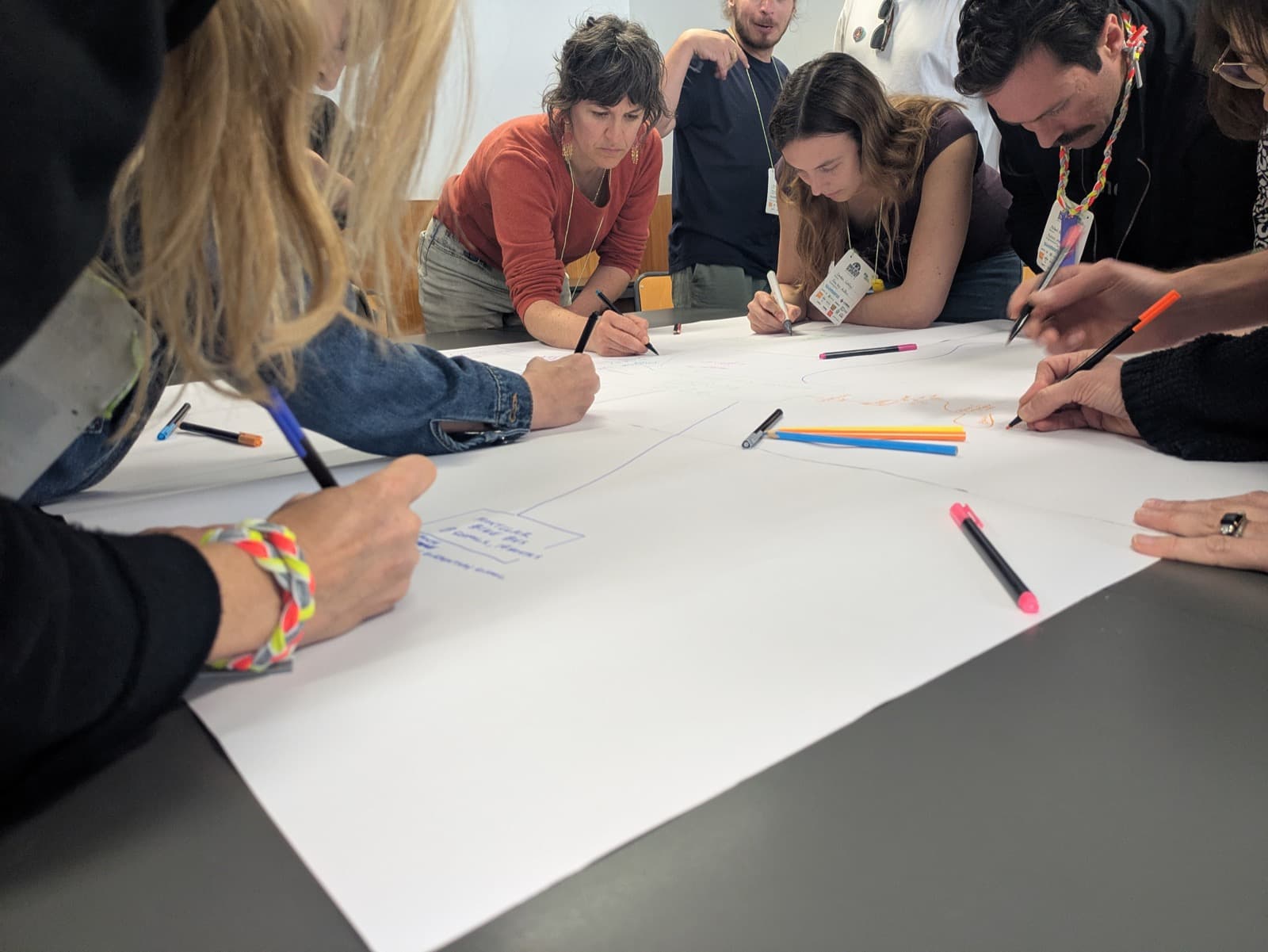
Draft journal post. First-person. Play Streets is the worked example for the "a session is never
only one thing" theme (see `a-session-is-never-only-one-thing.md`, folded in here). Facts marked
[ ] are placeholders until the Leisa transcript arrives. See `projects-section-plan.md`.
Draft
There is a version of a play street that arrives with a road closure, a council order, a sign at each end and a legal notice. [PLAY STREETS: name the session and date.] This wasn't that.
What we did was gentler and more improvised. We asked residents, nicely, to take a different route in their cars for an afternoon. No order, no barrier, just a conversation and some chalk. It is worth saying that plainly, because being honest about what it was is part of the point. We did not have permission to close the road. We had a relationship with the people who live there, and we used it.
[DESCRIBE THE AFTERNOON: what was on the street, what children did, what adults did, who turned up, what the weather did.]
Here is the thing I keep coming back to. On paper, that was one activity: children playing out in a street. In practice it was a web of things happening at once. [LIST WHAT IT ACTUALLY WAS: a first proper conversation between neighbours; a live test of whether residents would change their route; a link between the school and the street; something the council could point at; a way for quiet people to take part without speaking in a meeting.]
This is how creative projects work, and it is worth saying out loud. When the thing on offer is play and making, the door is wide. It lets in people who would not come to a meeting, a consultation or an AGM. It mixes people who would not normally be in the same room: parents and pensioners, the council and the residents who usually avoid the council, one community group and another working two streets apart that have never met.
It also makes room for exploration. There is no wrong answer when the task is play, so people try things they would not try if they thought they were being assessed. [PLAY STREETS: one concrete moment of someone doing that. A child, a parent, a neighbour.]
And out of that comes reach. [PLAY STREETS: where it went next. Who is still in touch. What started afterwards. What the group is doing now.]
We are learning to describe our projects by their web instead of their headline. Not "we ran a play street" but "we ran a play street, and here is everyone who touched it and everywhere it went next". The activity is the door. The web is the point.
[QUOTE: Leisa, on what the session was for] [QUOTE: Resident or parent, Play Streets session]