
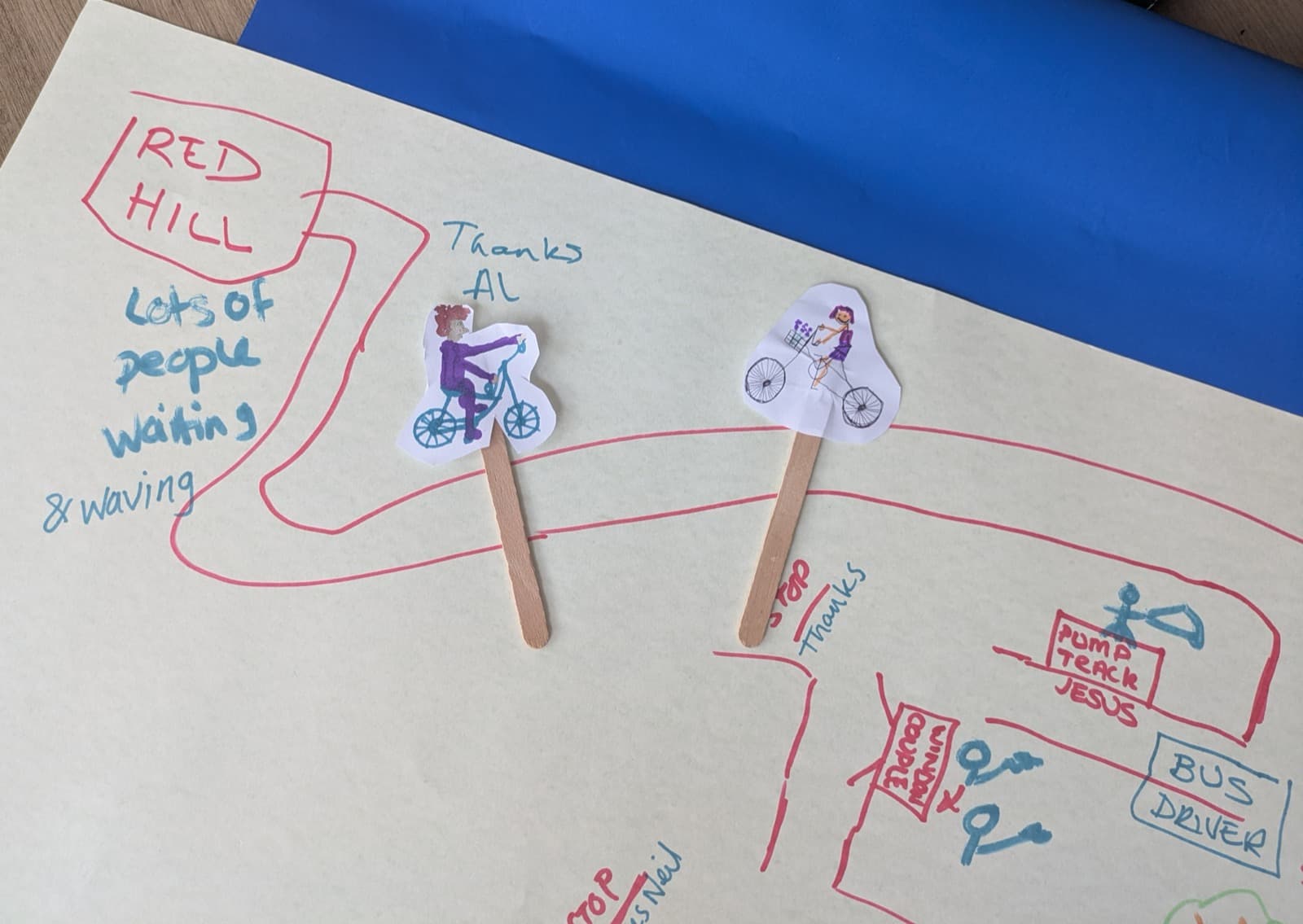
A project where children map their own route, name the people who cheer them on, and make a bell to thank them.
Draft case study for a project card. Written from the project outline, the workshop 1 transcript
and overview, and the session plans in
`context/colab_worcs_drive/Projects/Bike Bus Summit Lisbon/`. Facts marked `[ ]` still need Al.
Children are not named in public copy.
The situation
The bike bus already did its official job. It got children to school, and it took cars off the school run. But along every route there were people doing something that nobody had planned. The neighbours who leaned out of their window on Red Hill and waved every morning. The school caretaker who was always at the gate. The staff at Lucky's Lunchbox who cheered from the industrial estate. The man on the corner who shook a homemade set of cowbells, tin cans on a wooden handle, and used a road cone as a megaphone to shout good morning.
The children saw these people every week. Nobody had ever thanked them.
Bike Worcester had built the bike buses. We wanted to put children at the centre of the next bit and let them decide who mattered on their route, and how to say so. That became the Bike Bell Ambassadors project.
The approach
Three phases, all led by the children.
1. The workshop. A guided visualisation of the morning routine, then a soundscape of bells, gears, chattering and good mornings. The children named the sights and people along their route, and made an Atlas of the Bus. They drew themselves on their bikes and put the drawings on sticks, then rode the route again on large maps, marking the landmarks and the people who support them. 2. Design and fabrication. The children's drawings and words were printed onto custom weather-resistant ribbon straps, and the children embossed brass cowbells by hand, holding the stamp while an adult steadied it, then bringing the hammer down themselves. 3. The ceremony. The children gave the bells to the neighbours they had named, read the words they had written, and showed them what to do: ring it every week when the bus goes past.
What happened
The first workshop ran on Sunday 22 March 2026. [CONFIRM DATE.] It started 20 minutes late and the group was smaller than planned, two children plus facilitators. That made the room quieter, the session more intense, and the conversation more focused than it might have been with a full table.
The children ran the route in their heads and out loud. They heard "ding ding", gears changing, the chatter, and a lot of good mornings. They listed the swans on the canal that scare everyone, the dogs and the dog walkers, the allotments, and the hills they call Hill Number One and Hill Number Two. And they named the people worth a bell: Mr and Mrs Window, who lean out and wave on Red Hill every morning; Mr Deck, the school caretaker and a constant friendly face; the staff at Lucky's Lunchbox; and Gary, known to the children as Pumptrack Jesus, with his tin-can cowbells and his road cone.
Then, without anyone planning it, the session turned into a rehearsal. One child played the neighbour answering the door, the adult played the giver, and between them they worked out the questions a bell needs to answer. What is it? What is it for? What do I do? When do I do it? Why are you doing this? By the end, the answers were clear: you ring it when the bus comes past, at eight o'clock, to show respect, because these people show up for us.
[ADD WHAT HAPPENED AT THE CEREMONY: did it happen, when, who received a bell, what the children said, what the recipients did. The workshop produced the plan for it; the case study needs the day itself.]
Outcomes and learning
[ADD WHAT CHANGED: for the children, for the neighbours, for the route. Did the ambassadors start ringing the bells? Did more families join the bus? What is still running now?]
Honest reflection. [WHAT WOULD WE DO DIFFERENTLY. The first workshop started late and was condensed, and the visualisation landed differently for different children. Say what that cost and what we learned, in plain words.]
Voices
- [QUOTE: Child, Bike Bell Ambassadors]
- [QUOTE: A neighbour who received a bell, on what it meant]
- [QUOTE: Katie or Al, CoLab Worcs, on the moment the children named their people]